

Navigating the complexities of a modern skincare routine often feels like solving a chemistry puzzle. Among the most common points of confusion for enthusiasts and beginners alike is the correct sequence of application when dealing with liquid-based treatments. Specifically, the question of whether to use a serum or toner first is one that dictates how effectively your active ingredients penetrate the epidermis.
Because these two products serve distinct physiological roles—one primarily as a pH-balancing primer and the other as a concentrated delivery system for potent actives—getting the order wrong can diminish the efficacy of your entire regimen. In the professional world of dermatology, the rule of thumb is almost always to move from the thinnest, most water-like consistency to the thickest, most occlusive formula. By understanding the chemical properties and intended functions of these products, you can optimize your daily ritual for maximum absorption and skin health.
The Fundamental Role of Toners in Your Routine
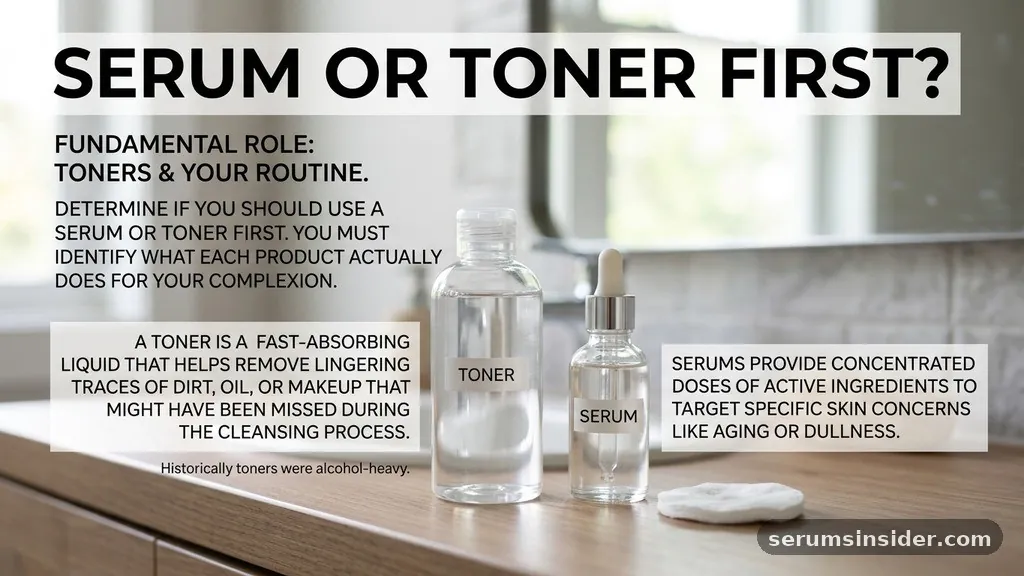
To determine if you should use a serum or toner first, you must identify what each product actually does for your complexion. A toner is a fast-absorbing liquid that helps to remove lingering traces of dirt, oil, or makeup that might have been missed during the cleansing process. Historically, toners were alcohol-heavy and drying, designed to strip the face of excess sebum.
However, modern formulations have shifted drastically; today’s toners are often hydrating, soothing, or mildly exfoliating. They serve as a crucial bridge between washing your face and applying your treatment products. By dampening the skin, toners create a more permeable environment, allowing subsequent layers of product to soak in more efficiently.
Think of the skin like a sponge: when it is completely dry, it is rigid and less absorbent. When slightly damp, it becomes pliable and ready to soak up moisture. Applying a toner immediately after cleansing ensures that your pores are prepped and the skin’s surface pH is balanced, which is particularly important if you have been using a high-pH foaming cleanser.
When you apply a toner, you are effectively resetting the skin’s baseline, making it the essential opening step in your post-cleansing routine. If you were to apply a concentrated treatment before this, you would essentially be applying it to a surface that is not yet primed to receive it, potentially wasting expensive active ingredients.
Why Serums Follow the Toning Process
Serums are high-potency formulations packed with concentrated ingredients like vitamin C, hyaluronic acid, or peptides. Unlike toners, which are designed to cover the entire face and balance the skin, serums are targeted treatments meant to penetrate deep into the dermis to address specific concerns such as hyperpigmentation, fine lines, or dehydration.
Because their molecular structure is designed for deep delivery, they require a clean, balanced, and slightly damp canvas to function at their peak. Placing them after the toner is not just a preference; it is a tactical decision based on product viscosity and chemical absorption rates.
When you use a toner serum sequence, you are layering from the most aqueous to the most viscous. If you were to apply a thick serum first, it would create a barrier on the skin that prevents the lighter, more watery toner from ever reaching the surface. Conversely, by applying the toner first, you provide a thin, hydrating layer that helps the serum glide over the skin without dragging or pulling.
This is especially important for those using active ingredients like retinol or alpha-hydroxy acids, which can be irritating. The toner acts as a buffer, ensuring the serum is distributed evenly across the face. For more information on skin barrier health, you can visit the American Academy of Dermatology to learn about how proper product layering supports long-term dermatological wellness.
Consistency and Viscosity: The Golden Rule of Layering
The primary logic governing the order of your skin care products is viscosity. In any professional skincare routine, you should always start with the thinnest consistency and work your way up to the thickest. This is because lighter, water-based formulas cannot penetrate through heavy, oil-based products.
If you attempt to apply a toner over a thick, creamy serum or a heavy moisturizer, the toner will simply sit on top of the product layer, unable to reach the skin. This defeats the purpose of using a toner entirely.
This rule holds true regardless of the brand or the specific marketing claims on the bottle. Even if a product is labeled as an essence, which sits somewhere between a toner and a serum, the rule remains the same: check the texture. If it feels like water, it goes on early.
If it feels like a gel or a lotion, it goes on later. This layering technique prevents pilling—that annoying phenomenon where your products ball up on your skin—and ensures that each layer has the chance to perform its specific function. Mastering this flow is the difference between a routine that yields visible results and one that simply results in product buildup.
Addressing Topical Gaps: When to Deviate from the Rules
While the general rule is to use toner before serums, there are specific scenarios where you might need to adjust your approach based on your unique skin type or the specific products you are using. For instance, individuals with oily skin might find that they prefer a more minimal routine, perhaps opting for a toner and a lightweight serum while skipping a heavy moisturizer entirely.
In this case, the toner acts as the primary hydration delivery system. If you are using an exfoliating toner that contains a strong acid, you may want to wait a few minutes after application to allow the pH of your skin to stabilize before you apply a serum that contains sensitive actives like Vitamin C.
Another gap in common knowledge involves the “damp skin” method. While we generally advise applying products to damp skin for better absorption, some active ingredients, particularly retinoids, are best applied to completely dry skin to minimize the risk of irritation. If you are using a potent retinol treatment, you might want to tone, wait for the skin to air-dry completely, and then proceed with your serum.
These nuances are what separate a generic routine from a truly customized one. Below is a simplified breakdown of how these products typically fit into a standard daily regimen.
| Order | Product Type | Primary Function |
|---|---|---|
| 1 | Cleanser | Remove impurities |
| 2 | Toner | Balance pH and hydrate |
| 3 | Serum | Target specific concerns |
| 4 | Moisturizer | Seal in hydration |
| 5 | Sunscreen | Protect from UV damage |
Common Mistakes When Applying Skincare Products
Many people struggle with their routine because they are rushing the process. The most common mistake is failing to allow one product to absorb before applying the next. When you apply a serum immediately after a toner without giving it even thirty seconds to settle, you are essentially diluting the serum.
This is especially true if your toner is very watery. By allowing the skin to “drink” the toner, you create a more effective foundation for the serum.
Another frequent oversight is ignoring the needs of the neck and chest. The skin in these areas is just as delicate as the skin on your face and often shows signs of aging just as quickly. Whatever you apply to your face should be carried down to the neck and décolletage.
Furthermore, many people forget that the order of application is just as important in the evening as it is in the morning. While you might use different products—perhaps a vitamin C serum in the morning and a retinol in the evening—the sequence of toner followed by serum remains the constant, reliable structure for your night-time skincare routine.
Optimizing Results Through Proper Technique
Achieving a healthy complexion is not just about the quality of the products you use, but the technique with which you apply them. When applying your toner, avoid rubbing it aggressively into the skin with a cotton pad, as this can cause micro-tears and unnecessary friction.
Instead, consider pressing the toner into your skin with your palms or using a soft, reusable bamboo pad. This gentle pressure encourages better absorption and is far kinder to your skin barrier.
When it comes to your serums, use your fingertips to gently tap the product into the skin. This “patting” motion improves circulation and ensures that the product is distributed evenly without pulling the skin downward.
If you are using an oil-based serum, remember that this should almost always be the final step before your moisturizer, as oils are occlusive and will prevent any water-based serums applied afterward from penetrating. By being mindful of these small, technical details, you can ensure that your skincare routine is working as effectively as possible, providing you with the glowing, healthy complexion you are aiming for.
Frequently Asked Questions
Can I skip the toner and go straight to the serum?
Yes, you can skip toner if your cleanser is pH-balanced and your skin feels comfortable after washing. However, if you have dry or dull skin, a hydrating toner can provide an extra layer of moisture and better prep the skin for the serums that follow.
Does it matter if I use a cotton pad for my toner?
Using a cotton pad is fine for exfoliating toners, as it helps physically remove dead skin cells. For hydrating or balancing toners, applying them with clean palms is often better because it prevents product waste and is gentler on your skin barrier.
Can I mix my serum and toner together?
It is generally not recommended to mix them in your hand before application. Each product is formulated with a specific delivery system in mind. Applying them separately ensures that the toner can properly prep the skin before the concentrated serum is applied to the surface.
What if my serum feels thinner than my toner?
While rare, if your serum has a thinner, more watery consistency than your toner, you should apply the serum first. Always prioritize the order of application based on the viscosity of the products, moving from the thinnest liquid to the thickest cream.
In conclusion, the debate over whether to use a serum or toner first is easily settled by looking at the fundamental principles of skincare: consistency and absorption. By starting with a toner to balance and prime the skin, you create the ideal environment for your more potent, targeted serums to work their magic. Remember to always layer from the thinnest to the thickest, be gentle with your application, and allow each layer to settle.
By following these simple steps, you can build a more effective, efficient, and rewarding routine that supports your skin’s health for years to come. Consistency is key, and once you have the order down, the path to radiant skin becomes much clearer.


