

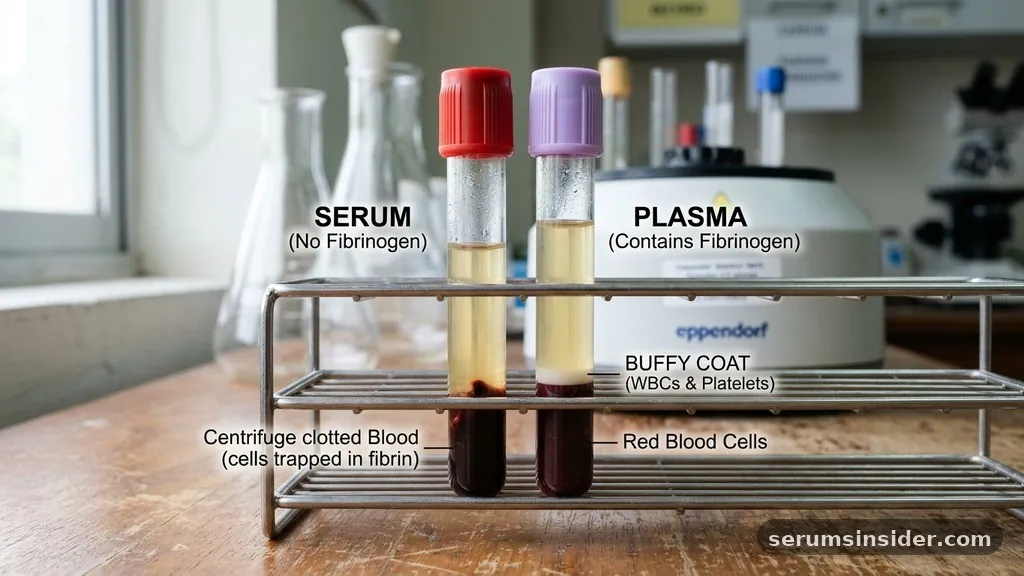
Understanding the composition of human blood is fundamental to modern medicine, yet many people remain confused about the specific distinctions between its liquid components. At its core, the primary difference between serum and plasma lies in the presence or absence of clotting factors. While both are derived from whole blood and appear as clear, yellowish fluids, the process used to separate them from the cellular elements—specifically red blood cells, white blood cells, and platelets—determines their chemical makeup and their suitability for various laboratory diagnostics.
When blood is drawn from the body, it naturally tends to coagulate to prevent excessive bleeding. If this process is allowed to occur, the liquid that is eventually harvested is known as serum.
Conversely, if an anticoagulant is added to the blood collection tube to prevent the activation of the coagulation cascade, the resulting fluid is classified as plasma. This distinction is not merely academic; it dictates which diagnostic tests can be performed and how clinicians interpret the resulting data.
The Biological Composition of Blood Components
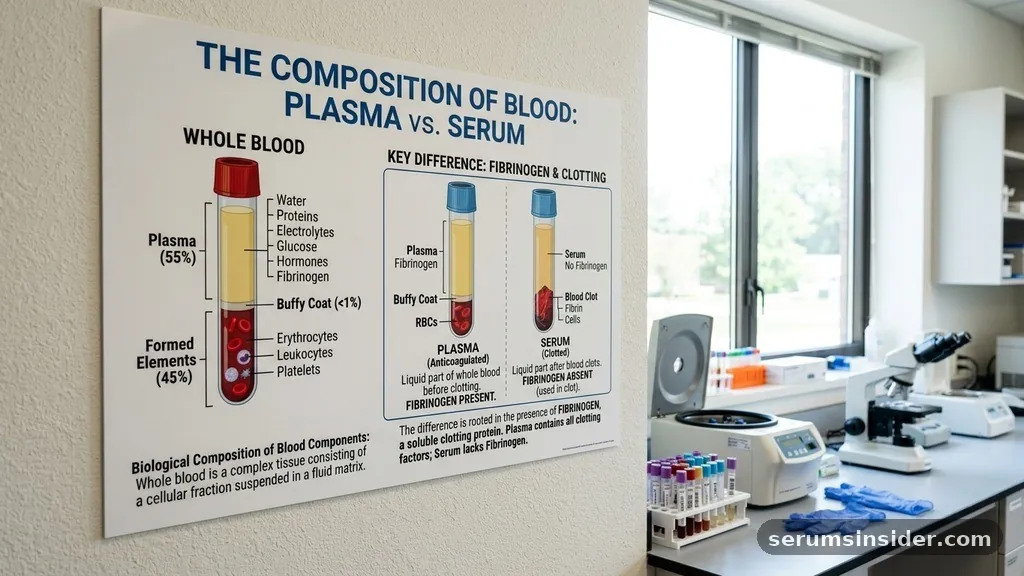
Whole blood is a complex tissue consisting of a cellular fraction suspended in a fluid matrix. When we examine what constitutes the liquid portion of blood, we are looking at a mixture of water, proteins, electrolytes, hormones, and glucose.
The plasma serum distinction is rooted in the presence of fibrinogen, a soluble protein that plays a critical role in the formation of a clot. In its natural state, plasma includes all the dissolved proteins necessary for coagulation.
When blood is collected for a plasma sample, the inclusion of an anticoagulant—such as EDTA, heparin, or sodium citrate—prevents the conversion of fibrinogen into fibrin. This means that when the blood is centrifuged, the liquid remains in a state that preserves the natural concentration of these clotting proteins. In contrast, when blood is collected without an additive and allowed to undergo clotting blood processes, the fibrinogen is consumed to create the mesh-like structure of the clot.
Consequently, the serum liquid that remains after the clot has retracted is essentially plasma minus the clotting factors. This fundamental shift in chemical composition is the primary reason why laboratories must choose the correct collection tube for specific diagnostic requirements.
How Laboratory Processing Defines the Output
The methodology of separation is the defining factor in determining whether you end up with a serum sample or a plasma sample. In a clinical setting, the sample preparation process typically involves high-speed centrifugation, which forces the heavier cellular components to the bottom of the tube. However, the timing of the centrifuge cycle and the type of tube used are critical variables.
For serum collection, the blood is drawn into a tube that contains no anticoagulant, or sometimes a clot activator to speed up the process. The blood sits for a period, usually 30 to 60 minutes, to ensure a solid clot has formed. Once the clot has fully developed, the sample is spun down.
The resulting supernatant is the serum. Because the clot has effectively “stripped” the fluid of fibrinogen and other coagulation proteins, the serum is considered a more stable medium for certain biochemical assays.
For plasma collection, the blood is drawn into a tube containing an anticoagulant. The sample is usually centrifuged immediately or shortly after collection. Because the anticoagulant prevents the coagulation cascade from initiating, the plasma can be separated from the cellular elements quickly.
This makes plasma a preferred choice for tests where speed is essential, such as emergency electrolyte panels or coagulation studies. You can find more detailed information on standardized blood collection procedures through the Centers for Disease Control and Prevention laboratory standards resources.
Comparing Key Characteristics: A Quick Reference
To grasp the difference between these two fluids, it is helpful to look at their physical and chemical properties side-by-side. The following table highlights the primary distinctions that laboratory technicians and physicians monitor when processing blood samples.
| Feature | Plasma | Serum |
|---|---|---|
| Clotting Factors | Present | Absent |
| Anticoagulant Needed | Yes | No |
| Preparation Time | Fast | Slower (requires clotting) |
| Fibrinogen | Present | Absent |
As shown in the table, the inclusion or exclusion of specific proteins is the main driver of the differences. While albumin is found in both, the specific absence of fibrinogen in serum makes it distinct. This difference is not trivial; it impacts how the sample interacts with testing equipment and how long the sample remains viable for analysis.
Clinical Applications and Diagnostic Utility
Clinicians choose between serum and plasma based on the specific diagnostic information they need to extract. Serum is frequently the default choice for many biochemical profiles, such as lipid panels, liver function tests, and hormone assays.
Because serum lacks the chemical additives found in plasma tubes, it is less likely to interfere with certain highly sensitive analytical methods. For example, some assays are sensitive to the presence of EDTA, which can chelate metal ions and potentially skew the results.
Plasma, on the other hand, is essential for tests that specifically measure the coagulation status of the patient. If you are testing for clotting disorders or monitoring the effectiveness of blood-thinning medications, you must use plasma.
Additionally, because plasma can be separated from the blood cells almost immediately, it is often used in high-throughput hospital settings where rapid turnaround times are required for patient care. The use of plasma is also standard for blood transfusions and for harvesting specific components for medical therapies.
- Serum is preferred for routine chemistry testing where anticoagulants might interfere with reagents.
- Plasma is mandatory for coagulation studies because it retains the necessary clotting factors.
- Plasma collection allows for faster processing since it does not require waiting for the blood to clot.
- Both substances contain high levels of albumin, which is essential for maintaining oncotic pressure in the body.
- The visual appearance of both is similar, often appearing as a pale, straw-colored liquid.
Topical Gaps: Addressing Common Misconceptions
A common question that arises in clinical settings is whether one fluid is “better” than the other. The answer is that neither is inherently superior; they are simply tools for different jobs. A frequent gap in understanding is the role of platelets in the separation process.
In serum production, platelets are often trapped within the fibrin mesh of the clot. In plasma production, platelets remain in the liquid phase unless specific centrifugation techniques are used to produce platelet-poor or platelet-rich plasma.
Another point of confusion is the color of the samples. While both are generally straw-colored, the presence of hemolysis (the breakdown of red blood cells) can cause both serum and plasma to appear pink or red. This is a common pre-analytical error that can affect both types of samples.
Furthermore, some patients wonder if the donors of blood contribute to these differences. While donor health affects the concentration of proteins like albumin, the fundamental distinction between serum and plasma is determined entirely by the laboratory processing technique, not by the source of the blood itself.
The Role of Proteins and Stability in Research
In the field of research, the stability of a sample is paramount. Because serum has already undergone the clotting process, it is often viewed as a more “stable” matrix for long-term storage in biobanks. The absence of fibrinogen means that there is no risk of the sample forming a secondary clot during storage or thawing, which can be a significant technical hurdle when working with plasma.
However, researchers must be careful. The process of clotting to create serum can actually cause the release of substances from platelets, such as serotonin or certain growth factors, which could introduce artifacts into a study. If a researcher is interested in the native concentration of these platelet-derived substances, plasma is the only viable option.
By using an anticoagulant, the researcher can effectively “freeze” the composition of the blood at the moment of collection, ensuring that the results reflect the physiological state of the patient rather than the processing method. This highlights why the difference between these two fluids is a critical consideration in experimental design, ensuring that the biological data collected is both accurate and reproducible across different study groups.
Conclusion
Distinguishing between serum and plasma is a fundamental aspect of clinical diagnostics and biomedical research. By recognizing that plasma is the liquid component of blood that retains clotting factors due to the use of an anticoagulant, while serum is the fluid left behind after the blood has been allowed to clot, professionals can ensure the highest accuracy in their work.
Whether you are dealing with routine patient blood work or complex laboratory research, the choice of sample type directly influences the integrity of the data. Understanding these nuances not only aids in the selection of the correct collection tubes but also deepens one’s comprehension of the intricate chemical balance of human blood.
Frequently Asked Questions
What happens to the fibrinogen in serum?
During the clotting process, fibrinogen is converted into fibrin, which forms a mesh-like structure to create the blood clot. Consequently, fibrinogen is removed from the liquid portion, meaning it is absent in the resulting serum.
Can I use serum for a coagulation test?
No, serum cannot be used for coagulation tests. Because the clotting factors, including fibrinogen, are consumed or trapped within the clot during the serum preparation process, the sample would not provide an accurate assessment of the body’s clotting ability.
Does the color of serum and plasma differ?
Generally, both serum and plasma appear as a clear, straw-colored liquid. However, if red blood cells have ruptured during collection, both can appear reddish or pinkish. There is no inherent difference in color between the two when processed correctly from a healthy donor.